Why Heidelberg Castle Was Never Rebuilt — and Left a Ruin

Heidelberg Castle is probably one of the most romantic places in Europe: the perfect fairytale ruins, perched above a storybook town.
A magnificent palace at the height of its glory, it was devastated by wars and misfortune.
But this is only part of the tale. It explains how the castle was destroyed, but not why it was left in ruins.
This is the story of why Heidelberg Castle was never rebuilt, and how a ruin became more powerful than the castle ever was in its prime.
The Castle at Its Height
Perched high above the Neckar River, Heidelberg Castle once stood as one of the most admired homes in the Holy Roman Empire.
Not a single building, but a grand complex of palaces and fortifications shaped over four centuries. It became a masterpiece of Gothic and Renaissance architecture.
Most importantly, it was the proud seat of the Prince-Electors of the Palatinate, rulers who helped choose the Holy Roman Emperor himself.
At its height, Heidelberg was a symbol of ambition, power, and beauty.
The Age of Destruction
But the world around Heidelberg was beginning to change.
In the early 17th century, the Holy Roman Empire slid into one of the most devastating conflicts in European history — The Thirty Years' War.
A war of shifting alliances, mercenary armies, famine, and disease, it led to the death of more than a third of the German population.
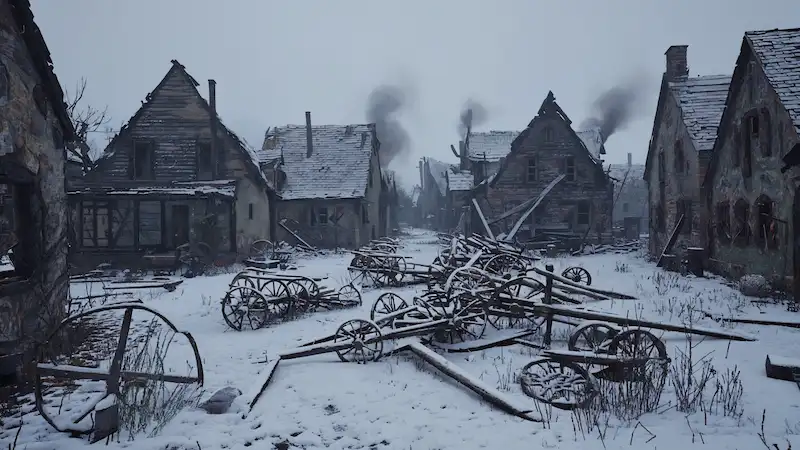
AI-generated illustration showing the devastating destruction caused by The Thirty Years' War
The Palatinate, positioned along major strategic routes, became one of its earliest victims.
The castle was attacked and damaged by imperial forces.
And yet—when the war finally ended—there was still hope.
Some repairs began. Life returned. It seemed Heidelberg Castle might rise again.
But the worst was still to come.
In the Nine Years' War, French forces under King Louis the Fourteenth sought to weaken the German states surrounding France.
Heidelberg was targeted deliberately — not just as a military stronghold, but as a symbol of Palatine identity.
In 1689, the castle was attacked and burned. In 1693, when efforts began to rebuild, the French returned and destroyed it again, this time with explosives.
The castle that once stood for pride and power was a wreck.
And, after two devastating wars, the question facing its rulers was no longer...
"How do we restore what was broken?" - It was: "Does rebuilding still make sense… in the world that now exists?"
The Turning Point
By the end of the 17th century, the Palatinate was weakened. Its political influence reduced, its treasury strained, and its priorities shifting.
Rebuilding was no longer just a matter of pride. It had also become a question of cost — and purpose.
The new trend sweeping Europe's elite was for sprawling Baroque palaces built on flat, open plains. These allowed for symmetrical designs and geometric gardens—perfect expressions of absolute monarchy.
But Heidelberg Castle, with its hilltop layout and war-damaged architecture, simply wasn't worth the enormous cost of a modern Baroque makeover.
And so, in 1720, Prince-Elector Charles Philip moved his court and the entire seat of power — to the nearby city of Mannheim.
Here, he could build a brand-new palace that was modern, impressive, and ideally suited to the tastes of the time.
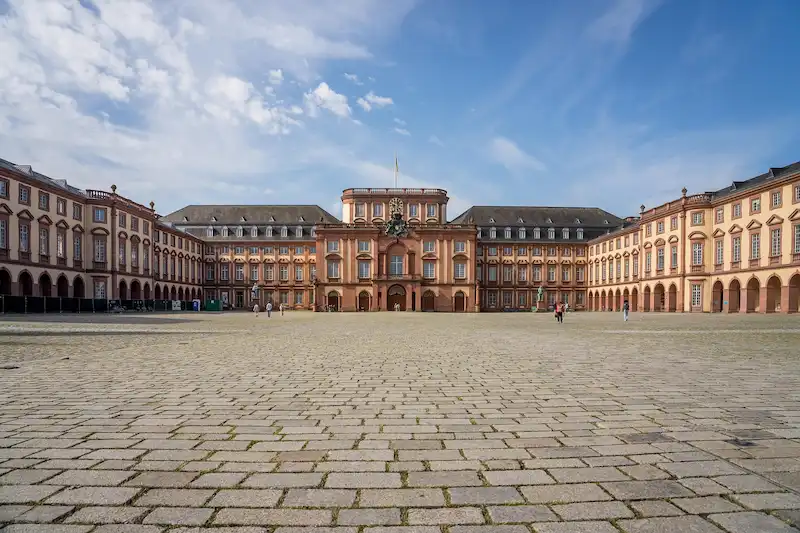
Mannheim Baroque Palace
That single decision sealed the castle's fate. It was no longer the center of political power; it was an obsolete relic.
Lightning Strikes
In an incredible twist of events, in 1764, the new Elector Karl Theodor was planning to move his court back to Heidelberg.
Parts of the castle were partially repaired when, in the summer of 1764, disaster struck: lightning fell upon the castle — not once, but twice—destroying the newly restored sections.
For the Elector, this was a sign from heaven. A message that the castle belonged to the past, not the present.
He abandoned his plans and left the castle for good.
The political heart of the Palatinate now beat in Mannheim, leaving the once-mighty Heidelberg Castle to crumble.
The Romantic Rediscovery
For decades, the castle lay in ruins. Locals were using it as a quarry, hauling away its stone and wood.
But then, something amazing happened. At the beginning of the nineteenth century, a new cultural movement began to spread across Europe.
This movement, known as Romanticism, sought to revive the beauty and mystery of medieval times, celebrating the art and architecture of that bygone era.
Suddenly, the castle ruins became a powerful symbol of German Romanticism, attracting travelers from all over the world.
Poets, artists, and writers, including Mark Twain and Victor Hugo, were all captivated by their picturesque, melancholic charm.
They weren't looking for a perfectly restored palace. To them, the ruin was not a failure; it was a powerful symbol of a glorious, lost era.
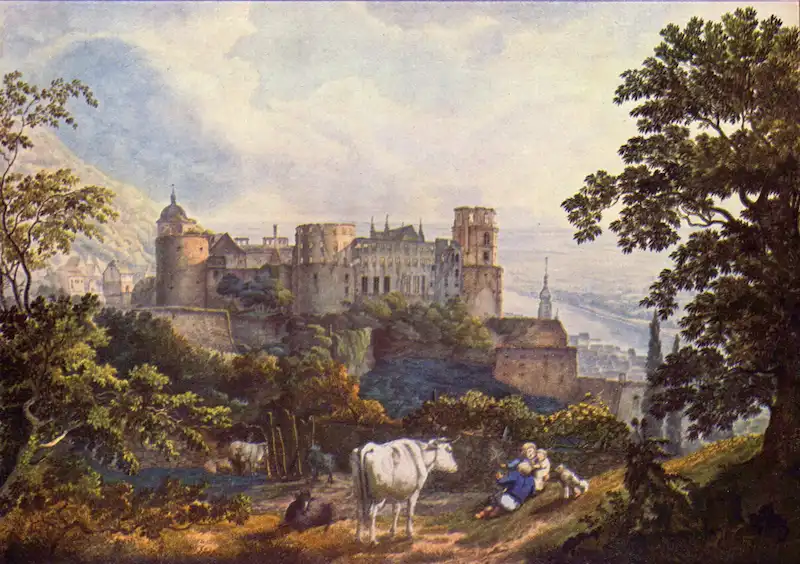
The ruins of the castle as portrayed in an 1815 painting by Karl Philipp Fohr
The Ruin as Identity
By the late 19th century, nationalism was on the rise in the new German Empire, and many called for Heidelberg Castle to be fully reconstructed as a monument to the nation.
This sparked a heated public debate.
On one side were those who wanted to restore the castle to its former glory.
On the other, the preservationists, led by the influential German art historian Georg Dehio.
In a statement that would become a cornerstone of modern historical preservation, Dehio argued that rebuilding the castle would create a fake. He famously declared that the goal must be "Preservation, not restoration."
He insisted that the castle's true value lay in its authentic, time-worn state.
In the end, Dehio's view largely won.
A commission of specialists decided against a full or partial rebuilding. Only one section, the Friedrich's Wing, was restored.
The rest of the castle was to be saved exactly as it was: a proud and noble ruin.
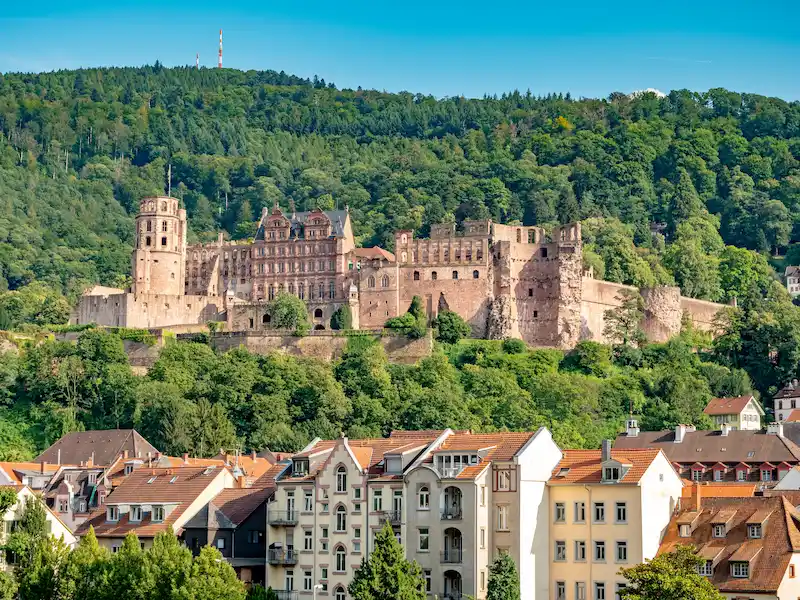
Heidelberg Castle - a proud and noble ruin
Why never rebuilt?
So, why was Heidelberg Castle never fully rebuilt?
The wars and the lightning were only the beginning.
First, the castle became politically irrelevant.
Then, just as it was about to fade away, the Romantic movement fell in love with its ruined state, seeing more meaning in the broken walls than in a pristine palace.
And finally, the preservationist movement, which consciously chose to protect the castle as a ruin, arguing that its authenticity was more valuable than any fantasy reconstruction.
Today, Heidelberg Castle is more than a landmark.
It is a place where visitors come to look out across the city and feel the past living quietly in the present.
History is not only preserved in what we rebuild.
Sometimes, it lives most deeply in what we choose to remember.
Next story:
Latest Castle Stories
Did the Holy Grail Escape the Fortress of Montségur?
Four men escaped Montségur in 1244 carrying a secret treasure. Was it the Holy Grail — or something even more powerful?
How Chenonceau Became a Bridge to Freedom in WWII
When France was divided in 1940, Chenonceau stood right on the border — and its gallery became a hidden path to freedom.
Corvin Castle: The Truth Behind Its Terrifying Stories
Dark legends haunt Corvin Castle — hungry bears, a cursed well, an immured monk, and Vlad the Impaler. But how much of this is true?
Irish Castles: Dark Secrets Hidden for Centuries
Terrifying spaces, underground defenses, and forgotten rooms uncovered inside Ireland’s castles.