Neuschwanstein Castle
★★★★☆
Neuschwanstein Castle is a masterpiece of Romanesque Revival architecture and one of Europe's most popular destinations.
In this video, we explore the story behind Neuschwanstein Castle - a romantic monument built by a reclusive king, filled with secrets, ambition, and breathtaking views of the Bavarian Alps.
Nestled amidst the Bavarian Alps, the castle seems straight out of a fairy tale. Its towering spires, pristine white walls, and dramatic setting have captivated hearts and imaginations for over a century.
The castle was commissioned by King Ludwig the Second of Bavaria as a tribute to Richard Wagner and a personal retreat from public life.

King Ludwig II of Bavaria
A sensitive and introspective soul, King Ludwig felt ill-equipped for the demands of ruling. His interests lay elsewhere, and he found solace in art, music, and architecture.
Deeply influenced by Wagner's romantic operas, Ludwig became a devoted patron and a close friend of the composer.

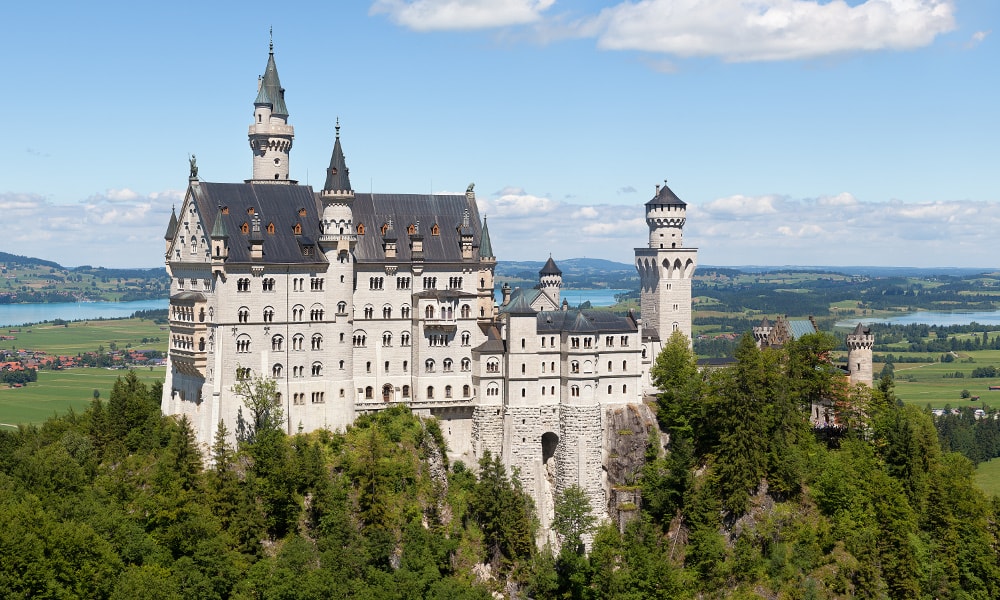
Neuschwanstein Castle and its beautiful setting
The swan concept, a symbol of purity and inspiration in Wagnerian opera, is prevalent throughout the castle, reflecting Ludwig's fascination with the motif.
In 1867, Ludwig visited the recently renovated Wartburg, a magnificent castle that inspired "Tannhauser," a well-known Wagner opera.
Here, the king was particularly inspired by the Singers' Hall, allegedly the location of the legendary "Singers' Contest."
The Wartburg and its hall became the leitmotif of the "New Castle."
He chose a site overlooking his childhood home, Hohenschwangau Castle.

Neuschwanstein Castle and its magnificent location
The location was perfect, offering stunning views of the surrounding landscape and a connection to his past.
Construction started in 1869.
The building of Neuschwanstein proved to be a monumental task, requiring immense resources and dedication.
Perched high on a cliff overlooking the Pollat Gorge, the site presented significant logistical challenges.

Neuschwanstein Castle at sunrise
Materials had to be dragged up the steep slopes, and innovative building techniques were employed to anchor the foundations.
As a result, construction took far longer than the king anticipated.
To make matters worse, Ludwig obsessively oversaw every detail of the design and construction, often making changes and additions that further slowed the progress.
The king chose to pay for the palace out of his personal fortune rather than using Bavarian public funds.
Sadly, Ludwig would not live to see his dream fully accomplished as the castle was never finished completely.
Richard Wagner passed away in 1883 without having the chance to visit the edifice.
King Ludwig died in 1886. He lived in the palace for only 172 days.
He never intended to make the palace accessible to the public.
And yet, seven weeks after his death, Neuschwanstein was opened to the public.

Neuschwanstein Castle, exterior view
It became the largest income source earned by the Bavarian royal family before World War One.
Today, more than 1 point 4 million people visit this enchanting castle every year.
Neuschwanstein's exterior is a stunning example of Romantic architecture. Towers rise towards the sky, topped with conical roofs and decorated with ornate spires.
The castle's white limestone walls contrast dramatically with the surrounding green forests.
Every detail, from the arched windows to the carved stonework, speaks to the meticulous craftsmanship of the era.

Arched windows and carved stonework
Credit: Shutterstock.com
The castle's design is a blend of historical styles, creating a sense of timeless beauty that transcends specific architectural periods.

Neuschwanstein Castle, interior courtyard
If the exterior of Neuschwanstein is a fairytale dream, the interior is a journey into the heart of Ludwig's imagination.
Elaborate wood carvings adorn the walls and ceilings, and lavish murals depict episodes from Wagner's operas, as well as scenes from medieval legends.

Interior with wood carvings and murals
Credit: Shutterstock.com
Only 15 rooms and halls were completed out of the 200 that were initially planned.
The largest room of the palace is the Hall of the Singers, with a design deeply influenced by the famous Singers' Hall from Wartburg.

Neuschwanstein Castle, the Hall of the Singers
Credit: Shutterstock.com
It was one of the king's favorite projects and, next to the Throne Hall, the most important room in the castle.
The Throne Room is a sumptuous hall inspired by Byzantine churches, which occupies two floors and an entire section of the Palace.

Neuschwanstein Castle, Throne Room
Credit: Dreamstime.com
It features a massive dome embellished with stars and a mosaic floor that shows the earth with its plants and animals.

Throne Room, ornated ceiling
Credit: Shutterstock.com
The palace was fitted with several of the latest technical innovations of the late nineteenth century. These include a central heating system, running warm water and toilets with automatic flushing.
From its terraces, the castle commands breathtaking views of the surrounding Bavarian countryside.

Neuschwanstein Castle, views and surroundings
Credit: Shutterstock.com
Lush forests cover the valley floor, while the snow-capped peaks of the Alps rise majestically in the distance.
Nearby, Hohenschwangau Castle, Ludwig's childhood home, provides a contrasting architectural style.
This nineteenth-century castle, built in a neo-Gothic style, reflects the tastes of Ludwig's father, King Maximilian the Second.
Neuschwanstein is a symbol of the permanent power of art and architecture. Its timeless elegance and romanticism continue to captivate hearts and minds.
Leave a comment
Latest Castle Stories
Medieval Dungeons: Myth vs Reality
Separate myth from reality as we explore what medieval dungeons really were — how prisoners were held, punished, and remembered.
Why Heidelberg Castle Was Never Rebuilt — and Left a Ruin
How war, politics, and Romanticism turned a once-great palace into a preserved ruin.
Life Inside a Medieval Castle — Power, Luxury and Survival
A look at daily life inside medieval castles, from noble privilege to the harsh realities of survival.
Reviews and impressions
TroyHill
It is by far the most beautiful castle in the world. I was amazed that it appears to be brand new.
Amy Redelinghuys
I was fortunate to experience this castle in the 1990's and found it to be breathtakingly beautiful.